If your kitchen counter disappears under a pile of gadgets every time you cook, you’re not alone. Small kitchens can feel chaotic fast, but the right setup changes everything. With a few smart choices, you can turn a cramped, cluttered space into one that actually works for you. This guide walks through the best kitchen organizers for small kitchens, the tools worth your counter space, and how to pick gadgets that do more with less room.
Table of Contents
Kitchen Tools That Save Time
Not every kitchen tool earns its spot in a small kitchen. The ones that do share one thing in common: they cut down on prep time without taking up permanent real estate.
Best Kitchen Organizers for Small Kitchens: Save Space and Simplify Cooking
Ingredients
Essential Space-Saving Tools
- 1 unit Multi-purpose vegetable chopper Such as the Fullstar Vegetable Chopper to replace multiple gadgets
- 1 set Stackable, nesting containers Must store flat when empty
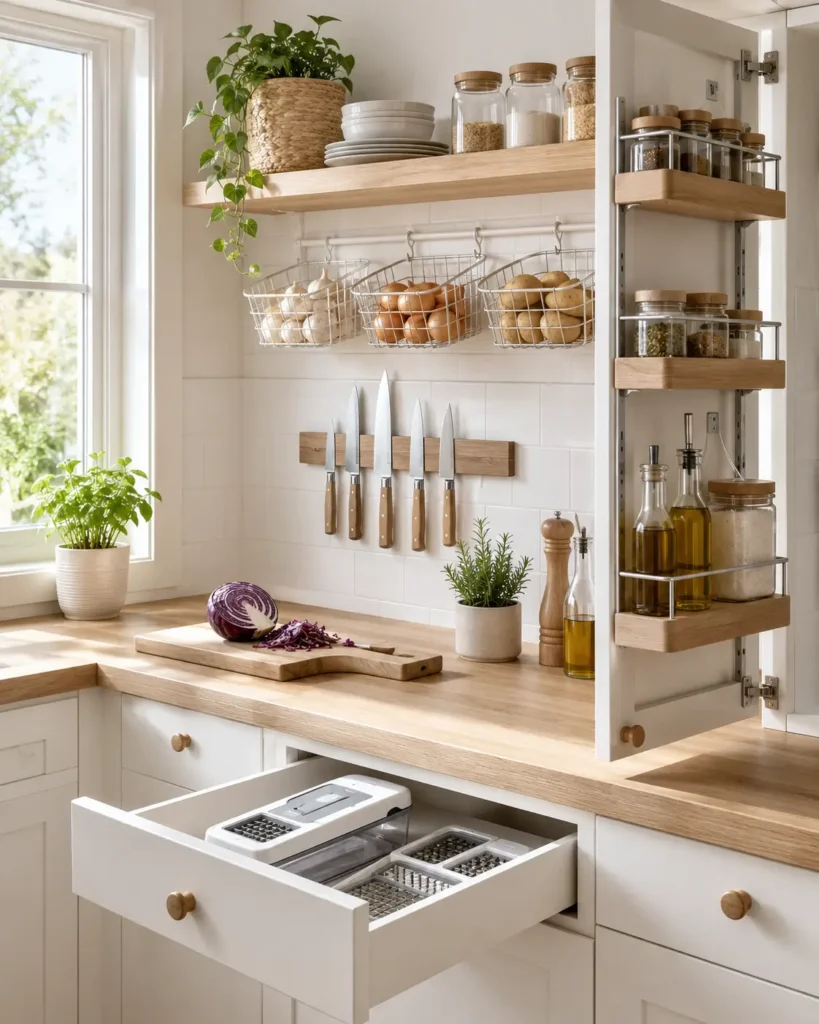
- 1 set Magnetic strips and hanging rails To free up drawer space for knives and utensils
- 1 unit Over-the-sink cutting board Adds a working surface without adding footprint
- 1 set Drawer dividers and lazy Susans Makes every inch of cabinet space usable
Instructions
- Group by task: Keep everything you need for morning coffee in one spot, baking supplies in another, and everyday cooking tools within arm’s reach of the stove. This keeps counters clearer between tasks.
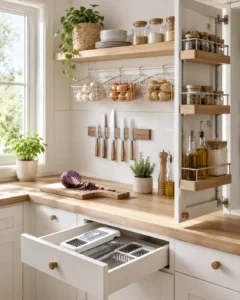
- Use vertical space: Look up and utilize walls or insides of cabinet doors. Add hooks, a pegboard, or a slim shelf above the counter for pots, lids, or spice racks.
- Keep only what you actually use: Be honest about duplicates. Decluttering mismatched containers and keeping only the tools you reach for regularly is the biggest space-saver.
Notes
A few categories consistently deliver the most value:
- Multi-purpose choppers and slicers that replace three or four single-use tools
- Stackable, nesting containers that store flat when empty
- Magnetic strips and hanging rails that free up drawer space for knives and utensils
- Over-the-sink cutting boards that add a working surface without adding footprint
- Drawer dividers and lazy Susans that make every inch of cabinet space usable
The goal isn’t to buy more tools — it’s to buy fewer tools that each do more. A good vegetable chopper, for instance, can replace a knife, a mandoline, and a dicer all at once, which matters enormously when counter space is limited.
How Do I Organize a Small Kitchen?
Organizing a small kitchen comes down to three habits: grouping by task, using vertical space, and keeping only what you actually use.
Start by grouping tools around how you cook. Keep everything you need for morning coffee in one spot, baking supplies in another, and everyday cooking tools within arm’s reach of the stove. This reduces the number of trips across a cramped kitchen and keeps counters clearer between tasks.
Next, look up. Walls and the insides of cabinet doors are often wasted space. Adding hooks, a pegboard, or a slim shelf above the counter can hold pots, lids, or spice racks that would otherwise crowd your cabinets.
Finally, be honest about duplicates. Small kitchens rarely have room for three can openers or a drawer full of mismatched containers. Keeping only the tools you reach for regularly is often the single biggest space-saver of all.
What Are the Best Kitchen Storage Solutions for Small Kitchens?
The most effective kitchen storage solutions for tight kitchens tend to share a few features: they’re stackable, wall-mounted, or foldable when not in use. Some of the most practical options include:
- Under-shelf baskets that hang from existing shelves without installation
- Tiered cabinet organizers that let you see and reach items stored at the back
- Door-mounted racks for spices, foil, or cutting boards
- Collapsible colanders and mixing bowls that fold flat for storage
- Drawer organizers sized for utensils, knives, or gadgets
These solutions work because they add function without adding volume the core principle behind organizing any small kitchen well.
Best Onion Choppers
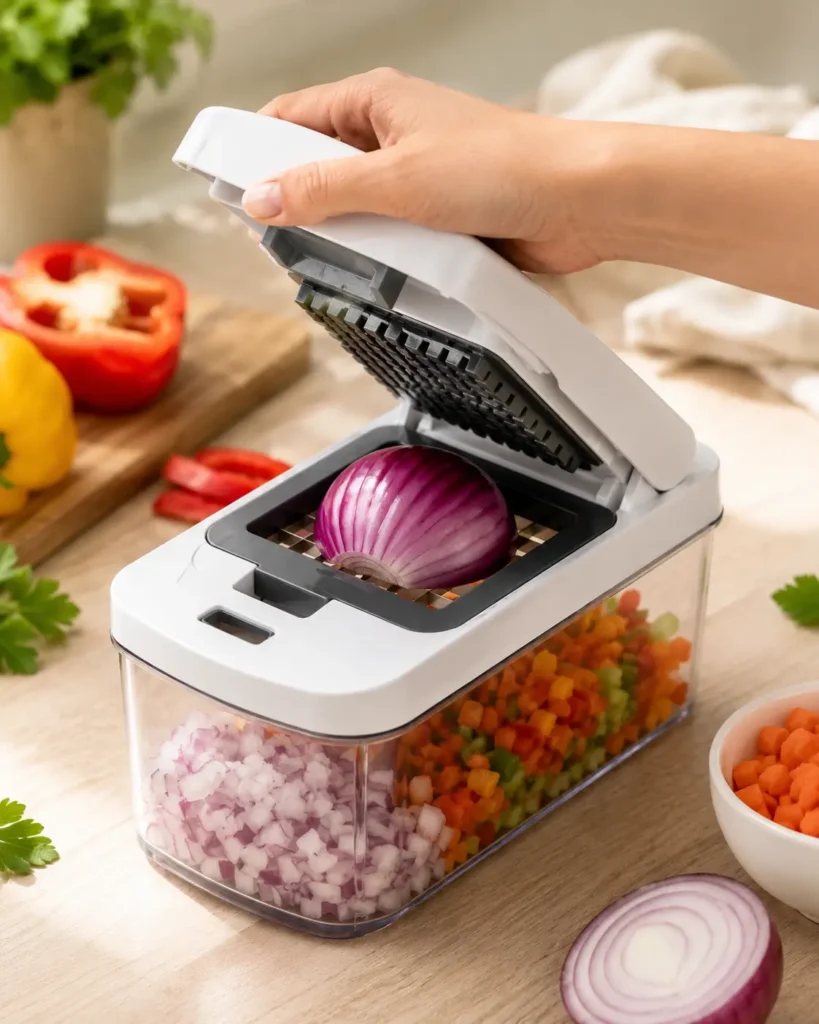
Onions are one of the most common and most tear-inducing ingredients to prep, which makes a dedicated onion chopper one of the highest-value tools in a small kitchen. The best models share a few traits: a compact base, a container that catches the diced onion directly, and a blade sharp enough to avoid mashing instead of cutting.
Look for choppers with:
- A locking lid to prevent spills mid-chop
- Dishwasher-safe parts for easy cleanup
- A non-slip base for one-handed use
- A storage container built into the design, rather than a separate bowl
A well-made onion chopper takes a two-minute task down to about fifteen seconds, with less mess and no need for a cutting board.
Fullstar Vegetable Chopper
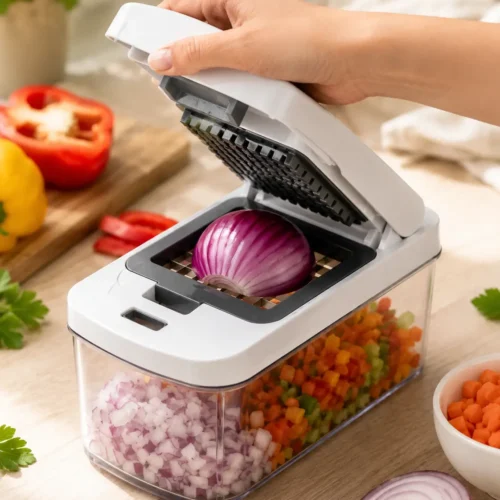
Among multi-purpose choppers, the Fullstar Vegetable Chopper has become a popular choice for small kitchens, largely because it consolidates several tools into one compact unit. It typically comes with interchangeable blades for dicing, slicing, and julienning, along with a container that stores the chopped food directly — no extra bowl needed.
What makes it a good fit for tight kitchen spaces:
- One tool, multiple functions: dicer, slicer, and julienne blades in a single unit
- Compact storage: blades often nest inside the base or container
- Easy cleanup: most parts are dishwasher-safe
- Consistent results: uniform cuts speed up cooking and improve presentation
For anyone trying to reduce the number of gadgets crowding a small kitchen, a chopper like this replaces a cutting board’s worth of prep tools with one item that stores in a single drawer.
Vegetable Chopper vs Food Processor
It’s a fair question: if a food processor can chop vegetables too, why choose a smaller chopper instead? The answer comes down to space, speed, and how you actually cook.
| Vegetable Chopper | Food Processor | |
|---|---|---|
| Counter space | Minimal, easy to store in a drawer | Bulky, often needs dedicated cabinet space |
| Prep speed | Very fast for small batches | Faster for large volumes |
| Cleanup | Few parts, dishwasher-safe | Multiple parts, more time to wash |
| Versatility | Best for chopping, dicing, slicing | Handles chopping plus purees, doughs, and grinding |
| Price | Generally lower cost | Higher investment |
| Best for | Small kitchens, quick daily prep | Larger kitchens, batch cooking, varied recipes |
For small kitchens, a vegetable chopper usually wins on practicality. It’s faster for everyday portions, takes seconds to clean, and tucks away in a drawer instead of claiming permanent counter space. A food processor still has its place for bigger cooking projects, but as an everyday tool in a compact kitchen, a good chopper is often the smarter choice.
Final Thoughts
Small kitchens don’t have to feel small. With the right combination of kitchen organizers, a few multi-purpose tools like a quality vegetable chopper, and some simple organizing habits, even the tightest kitchen can function like a much bigger one. Start with one or two changes a drawer organizer here, a dedicated chopper there and build from a kitchen that works with you, not against you.